


Summaries of YA books
- L. Moreno
- Jun 12, 2018
- 14 min read
Annie On My Mind
Garden, N. (1982). Annie on My Mind[Audiobook]. Retrieved June 5, 2018, from www.amazon.com

It’s a coming of age story of a 17-year-old girl who explores her sexual feelings toward another girl. It explores ideas such as the treatment toward people with a homosexual orientation in the 80s, the differences between affluent and low-income immigrant classes and highlights condemning arguments used by the religious movement of the time.
Set in an affluent suburb of New York, Liza Winthrop an all-American popular girl at a private school, holds the position of student council president. In an atmosphere where students get to govern themselves (mostly). Is being trolled by the sponsor Mrs. Pointdexter.
After a being suspended for not telling on a peer, Sally, who was conducting a clandestine ear-piercing operation in school, Liza began to distance herself from the school and began to explore the world outside of school.
Liza tries to clear her mind by going to a museum where she meets Annie Kenyon who after spending time with her falls deeply in love. The author Nancy Garden begins to explore the question many people who grapple with a gay identity of whether to come out to their family or not.
Liza is forced to come out after being caught with Annie half-dressed at their teacher’s house whom she was cat sitting for. Annie who originally spoke strongly about coming out, gets a “jail free card” and does not have to reveal to anyone her gay identity.
For this incident, Mrs. Pointdexter expels Liza pending a hearing before the school trustees. At this meeting, the witnesses Mrs. Baxter rants on about homosexuality as a disease, lust, and sin before God. Where Liza wants to get her point across that she is not sick, and she slowly fell deeply in love with Annie.
Eventually, Liza is allowed to come back to school and finish off her senior year at Foster Academy. Whereas, the teachers she was cat sitting for were fired for being bad influences on the students. The author, Nancy Garden, continues to point out that during this period in the fabric of America, it was commonplace for employers to fire people due their sexual orientation.
This story is told as flashbacks as Liza attempts to write to Annie while in her college dorm, and does not muster up the courage to mail off her letters. Liza eventually finds the courage to call her estranged girlfriend after being apart from her since June and on through the fall semester after graduation. Liza was happy to hear that Annie missed her just as much and would get to reunite over winter break.
Similar Books
Possible Way to Teach this Novel
HOW TO TREAT OTHERS WITH RESPECT https://pin.it/r2pdtsvk4wublc
Speak
Anderson, L. H., & Siegfried, M. (1999). Speak[Unabridged]. Retrieved June 8, 2018, from www.amazon.com

Melinda is an emotionally wounded freshman at Mayweather high school. As the school year begins she is un-friended by all her middle school friends and is unable to make any new friends except with a transfer student, the only person who does not know how she broke up a summer party by calling the police. Eventually the transfer student also dissolves her fledging friendship claiming that Melinda is too sarcastic, depressed and should seek help. Melinda’s compounds her problems by not speaking up at school activities with peers, teachers, or even at home with her parents. This book describes the sarcastic, problematic, and reluctant behaviors to a “t” of many angry teenage kids. Amidst the solace, Melinda finds peace in her Art class. Her art project about a tree must reveal her emotions and in the end, does reveal her soul. Will she reveal the truth as to why she is hiding behind a bitter persona? In her time, she does reveal to one of her ex-best friends, Rachel, that she was raped by Rachel’s current boyfriend, Andy. This book deals with the detrimental effect rape has on a person’s soul. At first Melinda is embarrassed, defeated and blames herself for being raped. Eventually she is liberated through her art. With having nothing else left to lose, she decides to tell her story. Andy becomes infuriated with the “rumors” spread about him and still under the misconception that both of them consented to the act since Melinda didn’t say anything on that summer night. In his outrage Andy confronts Melina and a fight ensues in a locked closet. The Lacrosse team attempts to intervene but discover a triumphant Melinda. This results in Melinda’s friends coming back to her, allowing her to break out of her desolation and becoming stronger after cutting off her “dead branches.” This book is typical of those that offer entering freshmen advise for what sorts of things happen in high school and offers a list of 10 lies they tell you in high school. It deals with the difficult topic forming relationships, keeping up grades, dating, rape, and finding oneself. Other books in the YA division by Laurie Anderson include Twisted which is also a New York Times bestseller, and Catalyst.
catalyst twisted
Gabi, A Girl in Pieces
Quintero, I. (2014). Gabi, A Girl in Pieces [Kindle Edition]. Retrieved June 12, 2018.
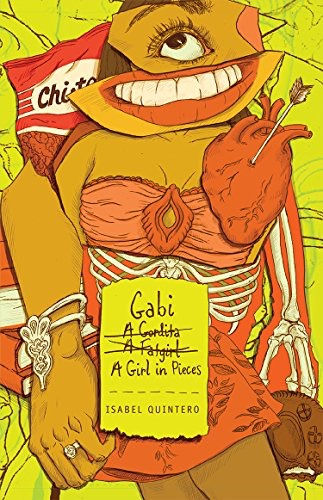
This YA fiction novel has an abstract plot, but has enough drama occurring to each character that it is not a boring read. Gabriela Hernández a high school senior wonders if her virgin lips will ever be kissed, let alone have sex. In her Santa Clara environment, there is teen rape, pregnancy, drug addiction, no tolerance for gay children, that we begin to wonder if Gabriela will achieve her academic goals of learning to write poetry and getting into Berkley. The author Isabel Quintero masterfully incorporates prose into her novel creating imagery and hitting the themes of the importance of family, you can’t change others, and true friends have your back no matter the consequences solidly on the head. I wish Quintero did not have to apologize through her characters for using Spanish and explaining every single Spanish word. As a matter of fact, the characters would be more believable if she just alluded English vocabulary through characters actions or description of the setting. At the beginning of the school year, Gabriela is on track to cross the stage provided she passed Algebra II, it was surprising to learn that because a fight she was not allowed to even witness her friend’s rite of passage from the audience. This book is your typical “how to get through high school” guide for Mexican Americans. Other novels like this are Erika Sanchez’ I Am Not Your Perfect Mexican Daughter, and Lilliam Rivera’s The Education of Margot Sanchez.

The Absolutely True Diary of a Part-time Indian
Alexie, S.( 2007). The Absolutely True Diary of a Part-time Indian [Kindle Edition]. Retrieved June 27, 2018, from www.amazon.com

This diary of a freshman’s high school experience on and off an Indian reservation completely engaged me, there was so much crying in the story that I had several episodes of tears dripping down my cheeks. There were so many parallels in my community where I grew up that allowed me to journey with Junior in this story.
In this fictional and almost autobiographical work by Sherman Alexie, Arnold Spirit Jr. battles to survive from the time he was born through the current story’s setting, high school. As a baby he overcame encephalitis, as a child he was always fighting other kids that made fun of him for his big head. When he hit puberty and his hands and feet grew faster than other parts of his body, he was made fun of and fought off his bullies, but always had his friend Rowdy who he could rely on whenever things went sour. I like how Mr. Alexie makes us feel as part of the story with its very believable tough guy and not so tough characters.
Once Junior hits freshman year of high school, out of anger he throws a book and it hits the math teacher, this was the catalyst that made him think of wanting a better future off the reservation. He had to decide whether he would stay schooling on the reservation and get lost and lose hope like everyone else in the community or if he would choose a different path?
Junior decided to go to high school in the more affluent neighborhood just outside of the reservation. Not only did he face rejection from his tribe and his best friend Rowdy for being a traitor and wanting more out of his life by transferring, he also faced no acceptance in his new school where he stood out as the only Native American in a primarily Caucasian farming community in Spokane, Washington.
Junior finds out that he is smart enough to be at this school and makes friends with another geek at the school. He befriends one of the prettiest freshman girls in school and they date. He also joins the basketball team where his teammates depend on him and he learns to believe in his skills. He learns that there isn’t a difference between white vs Indian or white vs. black. He learns the only true difference is in a person’s character, those who are nice vs. assholes as he tells one of his teachers after he returns from a 21-day hiatus from school. He was grieving for his grandmother who lost her life to a drunk driver.
This is a great coming of age book that helps young boys address issues of changing bodies, masturbation, spontaneous body reactions, appropriate male to male touch, boy-crying, team comradery, compassion, loss of a loved one, dealing with racism, bullying, and hope.
This book has won numerous awards and has been on many book list. Other books by Sherman Alexie include You Don't Have to Say You Love Me: A Memoir, and The Lone Ranger and Tonto Fistfight in Heaven: Stories.
sherman sherman tonto
Monster
Myers, W. D. (2008). Monster [Kindle Edition]. Retrieved June 21, 2018, from www.amazon.com

This YA fiction novel has won many awards and I can see why Myers’ Monster became such a big hit especially since it illustrates the experience of a black youth getting caught up in the penal system during a time in our contemporary Black Lives Matter protest. The main character Steve Harmon is a 16-year-old film student who was in the wrong place at the wrong time when a robbery-homicide took place and knew or rubbed elbows with the wrong type of people. Myers opens up the story in a jail cell where Steve narrates his memoir of the whole trial and reflecting deeply on the events that happened on the day the robber went down. Steve and his acquaintance James King are on trial for Felony Murder and can face a prison sentence from 25 years to life. The prosecutor has made deals with two other criminals who are pointing the finger and Steve and James. Steve deals with the question of what truth is and must decide what truth he will tell when he testifies.
This narrative is written as a film script and at the opening, we observe a scared Steve who successfully puts up a “no fear” front among his fellow prisoners who constantly look for fights, get beaten, and raped the jail cells surrounding him. Steve becomes depressed as the trial continues, but is able to keep it together for his mother and younger brother. His dad is not so sure about who Steve is anymore.
This book is a great example of the fears, the betrayal, and stereotypes youth live through in the penal system while they go through while their character is showcased for the world to judge. Other award-winning books and runner-ups by Walter Myers include Autobiography of My Dead Brother, PATROL: An American Soldier in Vietnam, Scorpions, NOW IS YOUR TIME!: The African-American Struggle for Freedom.
meyers scorpion myers all the myers autobiography
The Knife of Never Letting Go
Ness, P. (2018). The knife of never letting go (Kindle ed.). Retrieved June 24, 2018.
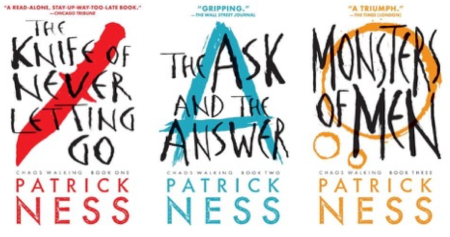
This MG science fiction novel has tones reminiscent of deep south idiosyncrasies in the language of the characters and the behavior of their town leaders. Mr. Ness has created a fantasy world where the thoughts of men are exposed for everyone to see. Animals and plants are also able to communicate using words and women can see the men’s exposed thoughts, but men are not privy to the women’s thoughts as they are able to keep their thoughts hidden.
The main character Todd Hewitt is the last boy in his town of men. The women and girls have all disappeared or died. Todd can’t wait to become a man since any of the boys who were close to him in age talk to him anymore because they have become men. At the beginning of the story, Todd is unhappy to be alone and angry that he has to take care of a pet dog (Manchee) that he never asked for. Things change when he accidentally comes upon an unknown presence in the swamp near his home in Prentisstown. The Prentisstown men are alarmed by Todd’s thoughts as he walks through town and want a word with him, but his protective adoptive father, Ben, decides to send him away to next town, Farbanks, to keep him safe from Prentisstown’s way of becoming a man (“If one falls, we all fall). As he runs away he encounters the first female he has ever seen in his entire life, Viola Eades. They escape together to Farbanks, as they are being chased by an army of Prentisstown and by Aaron, the preacher, who they believe is trying to kill them. Once they reach Farbanks they realize that they are still not safe and must continue on to the city of Haven. Aaron is not far behind them and practically leaves Todd for dead and kidnaps Viola. Will Todd, Viola, and Manchee reach Haven? Will Todd become a man? Will he ever be allowed to keep his thoughts private? What kind of man can he be if he himself kills another? Will he ever reunite with his father, Ben? Eventually, he does reach Haven only to find out that the Prentisstown Army has reached it first, meanwhile Viola is dying in his arms after their last encounter with Aaron, so in the last chapter a desperate Todd Hewitt is now willing to do anything in order to save Viola. Ness cliff hangs the first book of this trilogy, leaving the reader wanting to find out what will happen next.
In his journey, Todd learns that becoming a man is not about age, it’s about actions. He learns that he became a m
an well before his milestone birthday. The knife is a great use of imagery that represents protection at first, but becomes a tool to cut away the innocence of boyhood as Todd becomes a man. The archetype of baptism and rebirth are also very effective in showing Todd’s transformation. One of Todd’s major crutches at the beginning of the story is the lack of knowledge both of being illiterate and the lies he has been told about why there really were no women in Prentisstown. Viola who is close to his age, acts as his guide and voice of reason as Todd gains knowledge and truth and must decide for himself what hope is and how it has helped him overcome his symbolic death, the physical death of his dog and the impending death of Viola, whom he has come to love deeply.
This book is a great coming of age story that 13 – 15-year-olds could relate to. Its themes of truth, lies, tragedy, unity, and hope are told in a very fantastically believable setting that today’s teenagers can use as they come to grips with their own transformations.
The other books in the Chaos Walking Trilogy by Patrick Ness are The Ask and The Answer, Monsters of Men. His other prize-winning novels include A Monster Calls, More Than This, and Guardian.
patrick ness a th patrick monster
The Crossover
Alexander, K. (2014). The Crossover (Audiobook). Retrieved June 10, 2018 from www.amazon.com

This book is a great Middle Grade (MG) book. It reveals for black youth going through puberty how to deal with competition, family, and loss.
Alexander creates the characters of twin boys Josh and JB who grow up in a middle-class family where their mother works as a school principal and their father is retired from professional basketball. Although I listened to the story, you can hear the rhythm and beats coming through the story narration. I liked how the Alexander used the poetry format to tell a story and weave in some of the African-American hip-hop culture to show how JB gets jealous of his brother who now has a girlfriend and does not pay much attention to him anymore. The rhythm allows us to see how angry JB is that he is willing to foul and hurt his brother during a basketball game. JB is effectively punished by his parents, and his given the cold shoulder by his brother and his brother’s girlfriend, and his suspended from the team. He learns a hard life lesson on how to treat family and the importance of it. Is the punishment enough? Does he learn his lesson? Alexander culminates the boy’s father’s death as the boys play a very important end of season game.
At first, JB’s life is complete but he changes when he begins losing his brother and family. he learns the importance of family and staying together in hard times and holding his temper.
This book is your typical coming of age book. Because it’s a middle-grade book there are no explicit sex scenes or explicit language. It is a good book to have on your shelf for boys. It will speak to sportsmanship and camaraderie on and off the court.
Other books by Kwame Alexander include The Rebound, and Booked.
alexander 2 alexander 6
Staying Fat for Sarah Byrnes
Cruther,C (1993). Staying Fat for Sarah Byrnes (Kindle Edition) Retrieved June 26, 2018.

Cruther uses the swim team to set up friendships between key characters to masterfully bring out the emotion and drama between high school students in topics of bullying, abortion, religion, dating, and suicide that leads to a believable thriller in a fight for survival. He uses flashbacks to tie the main character Eric Calhoune (Moby) to his support system Sarah Byrnes (best friend), Steve Ellerby (swim team buddy), Jody Mueller (girlfriend), Cynthia Lermy (high teacher and swim team coach), Sandy Calhoune (mother) and Carver Middleton (mom’s boyfriend). Through the flashbacks, he puts into perspective the antagonist roles of Dale Thorton (middle school bully), Mautz (Vice Principal), Mark Brittain (swim teammate), Virgil Byrnes (Sarah’s abusive father).
The technical chapters that talk about working out in the pool are difficult to follow. Not being a swimmer myself, I was not able to appreciate the detailed swimming jargon. Crutcher almost lost me by chapter 2, I was ready to quit this book. But as Moby’s character was developed believable enough that I wanted to see how he transformed from a very scared junior high-fat boy to a hefty brave senior. The basic plot is that his best friend, Sarah, puts herself at a psych ward and struggles to pretend to be catatonic. She intentionally put herself there because she was trying to escape her abusive father. Mobe tries to get her help, but Sarah does not trust him or anyone. When Sarah finally tells Mobe of the horrific physical abuse she suffered at the hands of her father (intentionally burning her at the wood stove and disfiguring her face) Mobe seeks help from his swim coach Cynthia Lermy. Mrs. Lermy promises not to go child protective services and helps Sarah look for her mother so that she put into perspective the monster that is Sarah’s father, Virgil Byrnes. Even though her mother is found, she is uncooperative. Meanwhile, Mr. Byrnes suspects that Mobe knows where his runaway daughter is and comes after Mobe. Mobe is unwilling to reveal his friend’s location until he is faced with death. Will Mobe escape Virgil’s hunting knife that already drew blood from his cheek?
Crutcher uses the symbolism of the knife as a tool to cut out innocence. Mobe does survive the knife in his back, while Carver, his mom’s boyfriend, takes it upon himself to go find Virgil in revenge for putting Mobe in the hospital. After a struggle, Virgil is sent to the hospital with life-threatening injuries and then locked up for 20 years. Sarah is then adopted by the swim coach. Crutcher wraps up the story with a happy ending.
Choice is a topic that brought up in this high school class discussion in issues dealing with abortion. Crutcher does a good job at taking three points-of-view and laying them out as objectively as possible as they play out in the characters. He brings up the conservative religious point, the liberal religious, and the nonreligious point. After the discussion, Mark Brittain, conservative Christians, attempts suicide because after his adamant stance against abortion, is humiliated when it comes to light that he aborted his baby.
Crutcher wants the reader to draw parallels between almost being killed and surviving to attempted suicide. He wants to put into perspective that when someone decides to take their own life, it is a choice that person has made; even though many people feel responsible for not being friendly to the person who attempts suicide, ultimately it’s a personal choice. Whereas choosing to protect someone and getting yourself almost killed as a direct consequence, a person may go through the same thought process, fear and realization of impending death. Ultimately one is a coward and the other is a hero.
This book is your typical young man coming of age book. The archetypal baptism in the form of a swimming pool allows us to see the transformation from boyhood to manhood. Mobe physically sheds pounds and also sheds the weak fearful character as he transforms into a confident attractive intelligent young man. This book can also be categorized as a thriller.
Other books by Chris Crutcher include Losers Bracket, Running Loose, Stotan!, and Chinese Handcuffs.


Comments